A Word Study Before We Build Anything on It
I want to spend some time with a single Greek word before I start using it as a framework. The word is phronesis (φρόνησις), and it’s become something of a keyword in my research into how Christian marketplace leaders form the judgment they use to run companies, lead teams, manage a department, or make the call that’s landed on their desk, whether they feel ready for it or not. It’s tempting to grab a word, decide what it should mean, and start building. I’d rather slow down first and see what the word is actually doing, in Aristotle and in Scripture, before I hang anything on it.
A Word Aristotle Made Famous
Phronesis shows up well before the New Testament. About 325 years prior, Aristotle gives it a technical sense in Book VI of the Nicomachean Ethics. He names five states by which the soul grasps truth, in this order: art (techne), scientific knowledge (episteme), practical wisdom (phronesis), philosophic wisdom (sophia), and intuitive reason (nous).[i] To visualize his taxonomy, the rational soul splits into contemplative and calculative. See the figure below on how these build out.
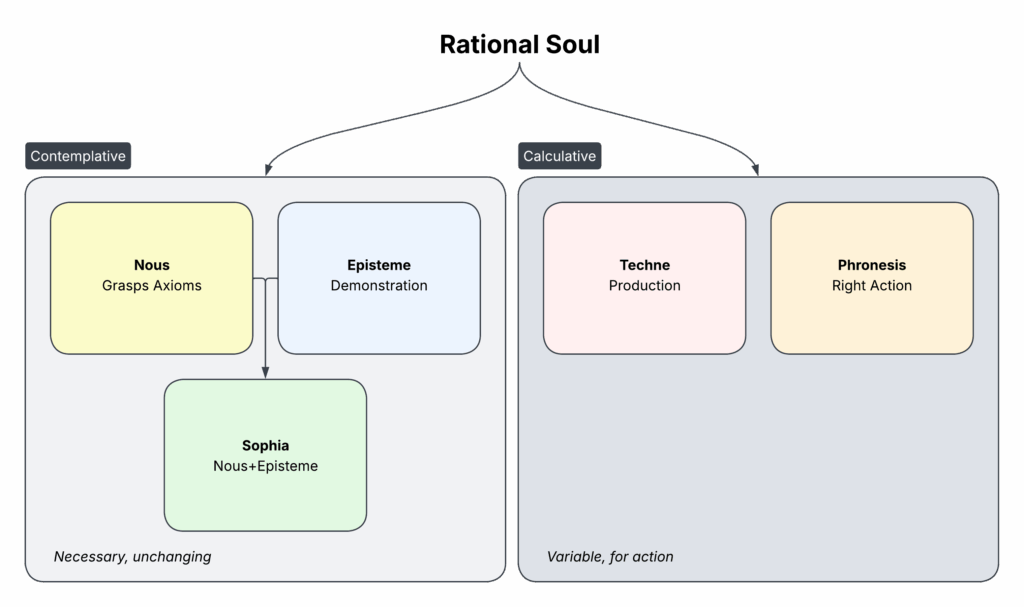
Practical wisdom, the one we’re after, he defines as the capacity to reason well about what’s genuinely good or bad for a person, worked out through action rather than through contemplation.[ii] Or the right action taken (ideally through a biblical worldview). Philosophic wisdom, in his scheme, deals with unchanging first principles, the kind of thing you can study and settle once. Practical wisdom deals with particulars that shift from one situation to the next: this employee, this deal, this Tuesday. It can’t be taught the way geometry can. It’s built through repeated exposure to real decisions with real consequences filtered through life experiences.[iii]
That distinction matters for where this is headed. Most people leading in the marketplace, whether they’re running the whole operation or three years into their first real leadership role, don’t lack information. What’s harder to come by is the judgment and wisdom to apply it rightly in a specific, unrepeatable moment: this hire, this customer, this Tuesday. Aristotle had a word for that gap. The question is whether Scripture does too, and if so, whether it’s the same word.
Where Phronesis Truly Appears in the Greek New Testament
Here’s the first honest thing to say: the noun phronesis itself is rare in the New Testament. It appears exactly twice. Let’s unpack these 2 verses.
The first is Luke 1:17, where the angel Gabriel tells Zechariah that his son will go before the Lord “in the spirit and power of Elijah, to turn the hearts of the fathers to the children, and the disobedient to the understanding [phronesis] of the righteous…” Wiersbe reads this as John the Baptist’s ministry producing not just a change of feeling but a genuine reordering of how people think and act, the practical, lived-out wisdom that marks a righteous life rather than an abstract idea about one, turning them back to the Lord’s ways.[iv] Louw and Nida define phronesis as “the psychological faculty of thoughtful planning, often with the implication of being wise and provident – ‘thoughtful planning, way of thinking, outlook’”[v] This is how we judge situations as leaders and then develop a God-honoring outlook.
The second instance is Ephesians 1:8, where Paul says God lavished grace on believers “which he lavished upon us, in all wisdom [sophia/σοφία] and insight [phronesis/φρόνησις]” in the middle of a long doxology about what God has done in Christ.[vi] Older commentators like Barnes take sophia here as the comprehensive intelligence behind God’s plan of salvation, with phronesis as the practical discernment that knows how and where to apply it.[vii] Paired that way, the two words read almost like Aristotle’s own distinction, borrowed and redeployed for something Paul is saying about grace rather than about virtue.
That’s it. Two New Testament occurrences, in two very different contexts, neither of them building a doctrine around the term. If someone wants to argue that “biblical phronesis” is a major, repeated New Testament category, the noun alone won’t carry that weight.
As a sidebar, we also see this pairing of sophia and phronesis if we dig deeper into the Septuagint (a Greek-Hebrew Bible translation from the days of Christ). Proverbs 1:2 states, “To know wisdom and instruction, to understand words of insight.” Or “ginosko sophia kai paideia noeo te logos phronesis.” (Septuagint transliteration) In the Septuagint, phronesis is used 37 times within the books under the Protestant canon. But that’s an article for another day.
The Wider Word Family Is Where the Real Soil Is
The noun usage of phronesis is thin. The word family it belongs to is not.
Phronimos (φρόνιμος), the adjective form, appears fourteen times, and it’s doing real theological work in some well-known passages. It’s the wise man who builds his house on rock rather than sand (Matt. 7:24). It’s the shrewdness Jesus tells the disciples to have, like serpents, heading out among wolves (Matt. 10:16). It’s the faithful servant put in charge of the household (Matt. 24:45) and the five virgins who thought to bring oil for their lamps (Matt. 25:2, 4, 8-9). Luke uses it for a manager entrusted with real responsibility (Luke 12:42; 16:8). Paul uses it twice as a warning rather than a compliment, telling the Romans not to be “wise in your own estimation” (Rom. 11:25; 12:16).[viii] Across all fourteen uses, the pattern holds: this is wisdom that shows up in a decision, a delegated task, a household managed well or badly. It’s judgment under responsibility, at whatever level that responsibility sits, which is almost exactly what I’m trying to understand about how Christian marketplace leaders are formed.
Then there’s phronema (φρόνημα), the noun for a settled mindset or orientation, which occurs four times, all in one paragraph of Romans 8, contrasting the mindset on the flesh with the mindset on the Spirit (Rom. 8:6-7).[ix] And underneath all of it sits the verb phroneo (φρονέω), “to think” or “to set one’s mind on,” which Paul reaches for constantly, including in his charge to the Philippians to have the same mind in themselves that was in Christ Jesus (Phil. 2:5) and his warning not to think of yourself more highly than you ought to think (Rom. 12:3).
It’s a family of related words, all children of one root (φρήν, transliterated phrēn), all clustered around the same idea: thinking that’s tested by what it produces, not just by what it knows.
So What Is “Biblical Phronesis”?
I want to be careful here, because this is exactly the point where a word study can quietly turn into an argument dressed up as a discovery.
Scripture’s own vocabulary for the kind of wisdom I’m interested in runs mostly through sophia and the Hebrew wisdom tradition behind it (chokmah), the territory of Proverbs, Job, and Ecclesiastes. Phronesis as a standalone noun is a minor player. “Biblical phronesis,” as a phrase, is a constructed category. I’m borrowing a word Aristotle sharpened for his own purposes and using it to name something Scripture teaches primarily through other vocabulary, mainly the phronimos texts and the broader wisdom literature. That’s not illegitimate. Theology does this constantly; “Trinity” and “inerrancy” aren’t found verbatim in the biblical text either, and both name something the text genuinely teaches. But it does mean the label needs to stay a label. Aristotle can lend a word. He doesn’t get a vote on what that word means once it’s describing something Scripture, not Aristotle, has final authority over.
One more note on sourcing, for the sake of being upfront: some discussions of phronesis cite Wisdom of Solomon 3:15, which does use the word. I’ve left it out of the evidence above on purpose. The Wisdom of Solomon is Apocrypha, not part of the Protestant canon, and it doesn’t carry Scripture’s authority, even though it’s useful as background on how the word was used in Hellenistic Jewish writing around the same period.
Where This Conversation Goes Next
This is the ground floor. From here, I’m planning to dig into a few of these texts on their own: Luke 1:17 and what it means for John’s ministry to produce phronesis in a disobedient people, Ephesians 1:8 and the sophia and phronesis pairing in Paul’s doxology, and the wise-builder and wise-manager parables as source material for what practical wisdom looks like under real responsibility. Each of those deserves its own careful pass rather than a mention in a survey piece.
If you’re leading in the marketplace, whatever that looks like for you right now, here’s an early, unfinished thought worth sitting with: your best decisions probably weren’t made by having more information than everyone else in the room. They were made by a settled way of thinking, shaped over time to see a specific situation rightly. Scripture has a great deal to say about how that gets formed. We’re just getting started on where.
Footnotes
[i] Aristotle, Nicomachean Ethics, trans. Robert C. Bartlett and Susan D. Collins (Chicago: University of Chicago Press, 2011), bk. 6, 1139b–1140a.
[ii] Aristotle, Nicomachean Ethics, 1140b.
[iii] C. D. C. Reeve, Aristotle on Practical Wisdom: Nicomachean Ethics VI (Cambridge, MA: Harvard University Press, 2013), introduction and commentary on 1140a–1141b.
[iv] Warren W. Wiersbe, The Bible Exposition Commentary, New Testament vol. (Wheaton, IL: Victor Books, 1996), comment on Luke 1:17.
[v] Johannes P. Louw and Eugene Albert Nida, Greek-English Lexicon of the New Testament: Based on Semantic Domains (New York: United Bible Societies, 1996), 324.
[vi] 7Albert Barnes, Notes on the New Testament: Ephesians, comment on Eph. 1:8.
[vii] Joseph Henry Thayer, A Greek-English Lexicon of the New Testament, s.v. “φρόνιμος.”
[viii] Albert Barnes, Notes on the New Testament: Ephesians, comment on Eph. 1:8.
[ix] Rom. 8:6-7. On the semantic range of the φρον- word group, see Thayer, s.v. “φρόνησις,” “φρόνιμος,” and “φρόνημα”; and Frederick William Danker, ed., A Greek-English Lexicon of the New Testament and Other Early Christian Literature, 3rd ed. (Chicago: University of Chicago Press, 2000), s.v. “φρόνησις.”